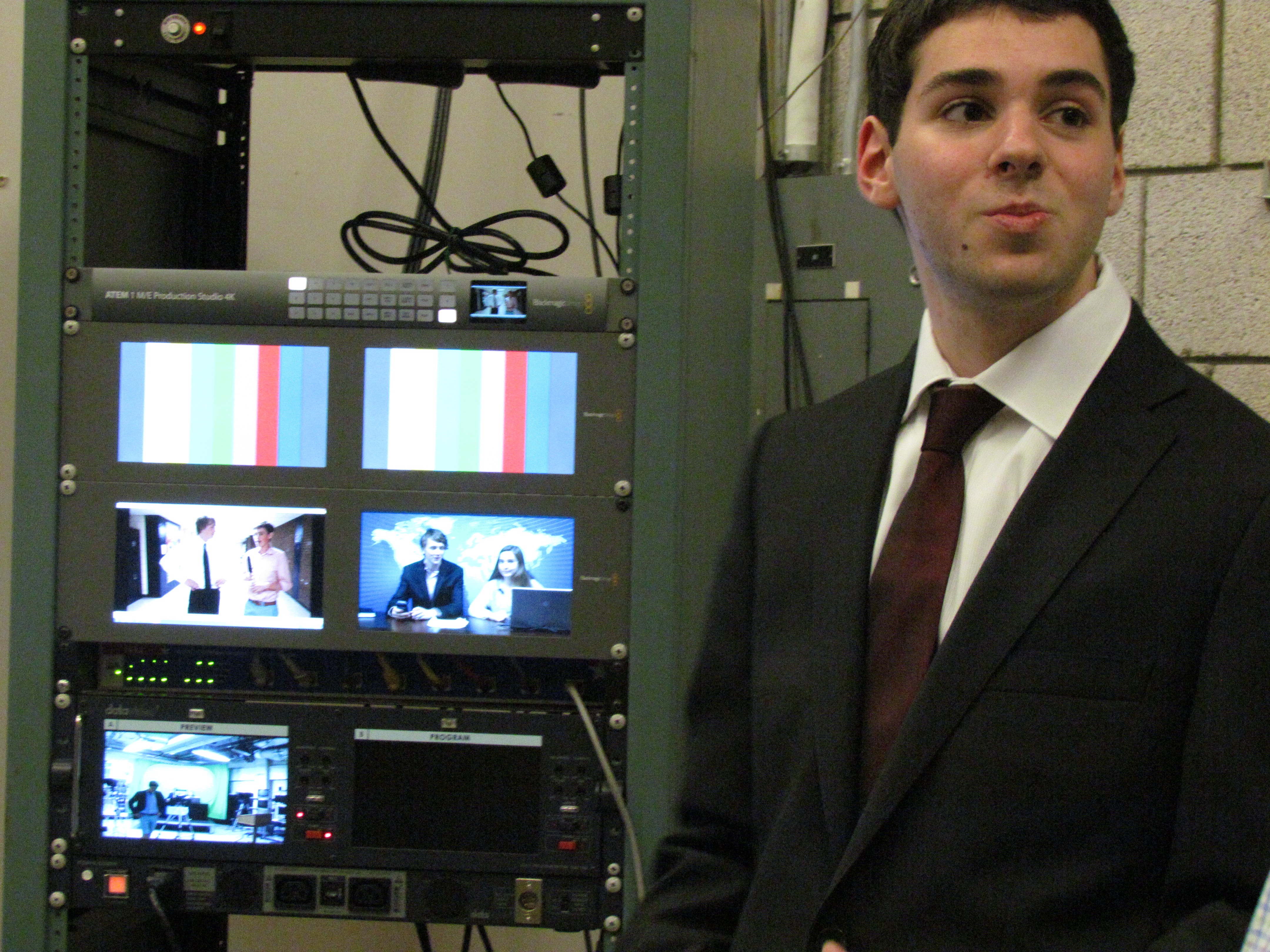
Thanks to a grant from the Wilton Education Foundation and some very talented and dedicated students, Wilton High School is now home to a video production program with what student organizers are calling “the most advanced video production system in the state.” Tuesday evening, June 10, video production club students showed off their expanded TV studio and new equipment at a presentation held for school officials, WEF board members and teachers, explaining what kinds of production they can now do and how students were instrumental in getting everything set up.
To demonstrate what types of production both club members and video production students can now learn and create, the students demo’d a few videos they have produced. Those videos will be broadcast when the new, student-produced morning television show, Morning Warrior, debuts on the high school TV network this morning.
Morning Warrior is a live television show, completely produced, directed and hosted by students. There are news anchors, field reporters, sportscasters, and behind-the-scenes production techs–all of them, WHS kids. GOOD Morning Wilton got a first-look at some of the taped packages that will be rolled into Wednesday’s live show. [One can be viewed below, at the end of this article.]


The upgrades and improvements are part of an overall, district-wide effort driven by superintendent Dr. Kevin Smith. He approached WEF in March about funding the program to bring video cameras and production equipment into all four schools for students to use.
WEF chairman Brian Kessleman says this kind of program is exactly what the Foundation promotes, fundraises for and supports: “techonolgy, music, professional development days for the teachers, and curriculum advancements.”
The WHS Video Production class, taught by Kenneth Boehm, has been one of the most popular electives at WHS for many years. Students can produce their own videos on topics they find interesting and learn applicable and viable skills to help them in the ever-expanding computer coding and media industry.
Three years ago, some of Boehm’s most passionate students created and piloted their own club–a news show for the students of Wilton High School. Current senior Endy Perry joined the club at the very beginning and has stayed committed, working this past year as co-executive producer of the club alongside fellow senior Cooper Pellaton.
During Tuesday night’s demo, Perry led faculty and WEF members around the newly furnished studio. He says the WEF grant along with a Perkins grant helped in several ways. “We have transitioned from the original, aging equipment, to a newer brand, which is something that provides different levels of advancements,” he said, adding that the new gear allows the students to expand their technical capabilities in editing, camera shooting and other elements of production.


Perry says the studio was also expanded to accommodate a new control room. “The control room is a big part of our operation and we have several monitors in there. We’ll have editing stations as well as switchers, multi-view cameras, tv screens hanging from the walls, and that should be a pretty advanced set-up for us to use. And we are also getting a talk-back system so that people in the control room can talk directly back to the cameramen, as well as the anchormen who are on the set. And they’ll be able to communicate through the microphones that they have,” he explains.


Next year it’s likely that students will only produce the show once a week, but Perry envisions that increasing, thanks in part to the technological upgrade making production easier and enticing more students to participate.
“Once the new equipment we have starts picking up, and students are feeling more comfortable with that. We’ll also have the video production class at the high school, and one of their sole jobs will be to produce segments that will be aired on the show. So once we have the ability of more people and everybody gets comfortable with the equipment, we can eventually transition, I imagine in a year or two down the road, to this being something shown every morning at the high school,” he says.
On an even larger scale, Perry has helped school administrators to create a curriculum to go along with the new equipment that the three other schools will receive. Most similar to what is happening at WHS will be Middlebrook.
“We hope for them to at least have a club of some sort where they can learn some basic editing skills. We are purchasing several adobe products for them so that they can learn basic editing plus the ability to film segments and those can be shown either at their schools or online. [Soon] Middlebrook should be able to produce a news show, with generally very similar technology, just a matter of expertise on the students parts.”
Perry ticks off what he envisions across the district. “We could have a very efficiently run news show in the high school; we can have a slightly less intense, but still be challenging, show in Middlebrook; and something possibly in Cider Mill; and also have Miller Driscoll working with some of the equipment–probably not any news show–but they could have something similar.”
Perry explained one other program goal: to improve and increase the ability to distribute TV programs that students produce. “[District director of technology Mathew] Hepfer has been working on to allow streaming in the high school as well as I believe the other schools. So eventually this program will be able to be broadcast straight online, through the Wilton High School homepage or wherever, we will be able to have a live footage and streaming of this show.”
All of the adults involved in the project give major credit to the students who had led the way. Boehm has noticed that his students bring their own extensive knowledge and experience with the technology into the classroom, and according to Perry and others, has let them take a front seat. Boehm himself acknowledges this fact: “So much of this needs to be attributed to these fine gentlemen,” he says, referring to the club’s student leaders.
In fact, the bulk of the physical work of building the studio was done by students themselves, who often stayed at school as late as 11 p.m. many nights laying cables, putting together equipment and getting everything ready.


Superintendent Smith echoed that praise. “I could not be more proud of these students. I truly had nothing to do with this. The students really took control of it all.”
Perhaps the best sign is how excited the students are about what the upgraded technology will allow them to do. Quentin Burns, who will be senior producer for the 2015-16 school year, says the new studio and equipment is money well spent.
“The equipment is state of the art, everybody will be using this in ten years. Not only is it a creative outlet for a bunch of people, but it gives us a chance to learn on the state of the art, which is something that the school has been striving for for a while. Going beyond that, not only is it a source for news, but something that makes our high school unique,” he says.
Note: The editor of GMW is a member of the board of the Wilton Education Foundation.