

The Wilton Public Schools community along with the wider Wilton community will be hearing three terms with much more frequency this year: diversity, equity and inclusion. While these are not new topics for the school district, there is increasing focus and discussion around them from both an academic and a cultural approach — how they are incorporated into the curriculum as well as in day-to-day life within Wilton’s schools.
Assistant Superintendent for Curriculum Chuck Smith defined the terms during a recent workshop on diversity, equity and inclusion that school administrators held for members of the Board of Education.
- Diversity: making sure that the world’s various identities and differences (race, ethnicity, gender, ability, religion, sexual identity, etc.) are represented in the district and its curriculum
- Equity: ensuring that everybody is treated fairly, that there’s equality of opportunity, and fairness in access to information, through policies and practices
- Inclusion: making sure that everybody feels like they belong, that they have a voice, and that they’re able to participate in the culture of the school.
The district has had different diversity and equity initiatives in place for many years — consider the work done for students in special education as just one example. But the current effort to sharpen the focus and closely examine curriculum and practices through the diversity, equity and inclusion lens intensified recently for several reasons:
- Notably, in 2020, Wilton High School alumni wrote an open letter to the Wilton Public Schools administration calling for a change in how race is taught, discussed and represented in the schools. It was signed by well over 600 past and present students asking for several changes, including eliminating the “race-blind” narrative used and taught in Wilton curriculum; adding specific historic events and texts to the curriculum; increasing diversity in hiring by actively looking at institutional barriers that may prevent teachers of color from applying; and holding students or teachers who make racist and offensive remarks accountable with constructive punishment.
- Administrators also point to Wilton’s changing demographics, both in the schools and in town. In less than 20 years, the district has shifted from having fewer than 5% of students who were not white to 25% of the student body identifying as students of color. What’s more, the 2020 census showed that in just 10 years Wilton’s non-white population almost doubled, growing from 10% to 19.6%.
- Current events of the last year have brought issues of diversity to the forefront of discussion, something students of all ages have witnessed outside of the classroom. Acknowledging that differences are part of history, today’s society and what students will experience in the future, the district calls “learning how to engage productively with people of differing backgrounds, abilities, and experiences” essential for students to be successful in school and later in life. As Superintendent Kevin Smith puts it, “We have an educational obligation to ensure kids are exposed to different perspectives, to minority perspectives, to perspectives that have been previously marginalized … and really ensuring that there is more than a singular perspective or historically dominant perspective.

In order to help Wilton residents better understand what the district is doing and what it means, GOOD Morning Wilton met with Kevin Smith; Chuck Smith; Karen Brenneke, the district’s K-8 humanities curriculum coordinator; and Michael Gordon, the Middlebrook Middle School music teacher who chairs the district’s Diversity and Inclusion Committee. The interview has been edited for brevity and clarity.
GOOD Morning Wilton: Why are we hearing about diversity, equity and inclusion now? There was last week’s BOE workshop, there’s a presentation on the district website, you’ll be holding conversations with families on the topic? Why now?
Dr. Kevin Smith: It’s not a new topic by any stretch of the imagination for any of us. We’ve had diversity initiatives and equity initiatives in place for many years. Probably people will relate to the work and efforts to serve our students with special needs.
More recently, we’ve taken a closer look at our curriculum and practices with a sharper lens around racial equity and inclusion. That’s where we have some growing to do. I wouldn’t say the work is different, because these are pieces that are embedded in our mission, our vision, our philosophy, and our frameworks. It is actually better because we’re paying closer attention.
Michael Gordon: As a town, historically, there’ve been pockets of folks who have also taken the initiative to bring equity and inclusion, especially in terms of race, to the greater public in Wilton — Project Concern and of course A Better Chance of Wilton — people who recognize there’s an element that’s very important and necessary. They’ve also reached out. So we’re just taking it to the next level.
Kevin Smith: We’re a much more diverse population than we were 20 years ago. Part of our obligation, part of what we heard from some of our alumni a year and a half ago was a call to ensure that our curriculum reflects everybody that lives here.
Beyond Wilton, the world is changing and growing more diverse. We have an educational obligation to ensure kids are exposed to different perspectives, to minority perspectives, to perspectives that have been previously marginalized. That’s a piece of it — we’re going back and reexamining curriculum and really ensuring that there is more than a singular perspective, or at least looking at addressing the historically dominant perspective that’s been embedded in the curriculum, at least here in the United States.
GMW: Examining and updating this curriculum is not just something you started at the beginning of the summer. What’s been part of Wilton’s curriculum before, how is it expanding, what role has the State of Connecticut played in this discussion, what changed legislatively this year?
Chuck Smith: Well, we are going to be implementing the new Black and Latino studies course, and that’s a mandate from the state.
The state hasn’t really mandated culturally responsive teaching, but it has certainly strongly endorsed it and supported it. What we want students to know and be able to do, taking perspective is one of those [things]. If we’re talking about diversity, equity and inclusion, a lot of that is around perspective-taking. But that’s been embedded in a lot of the work for a long, long time.
Karen Brenneke: These aren’t new concepts. In 1994, the National Council for the Social Studies published 10 themes that should be explored in a social studies class. And they’re echoed in the CT Frameworks for Social Studies. We teach to [those] standards. Where those topics come up is where we teach that. Here are five of them: culture; individual development and identity; individuals, groups, and institutions; power, authority, and governance; global connections. That’s just half those 10 themes.
Chuck Smith: Part of it is part of our normal curriculum review process.
Karen Brenneke: Social studies was done 2016-2017, and we were fully aligned to the CT Social Studies Framework Standards in 2018.
Chuck Smith: And it was two years ago 2019 that we did the English Language Arts review.
I would add, the “Portrait of the Graduate” is really driving a lot of this work. We’ve identified certain outcomes we want for our graduates and that’s naturally going to lead to some of this work. In the future, we’re going to be seeing this, maybe articulated a little bit of a different way, looking at the attributes of the graduate.


GMW: Nationally, in Connecticut, even locally — as close as New Canaan — people have objected to “Critical Race Theory,” or CRT. Can you explain the difference between Critical Race Theory and Culturally Responsive Teaching? What do they mean and what’s part of the conversation here in Wilton?
Chuck Smith: Critical Race Theory is a fairly high-level, college-level academic area of inquiry. And we don’t teach CRT here in Wilton. It’s not appropriate, or kids just aren’t ready for that level of inquiry.
That said, is race a lens through which we help our students to look at things? We absolutely do, but we’re not teaching those five tenets of Critical Race Theory.
That CRT thing has been taken up by a certain group of people without a deep understanding of what it means. And I think it’s being thrown around inaccurately and unfairly. But I want people to understand: true critical race theory is not part of our curriculum. But they need to be clear, that race is something that we do talk about with kids. We absolutely do. It’s an important lens for kids to look at things.
Karen Brenneke: Understanding history and its impact on the present and the future is what we teach our children. And we’re teaching that with more inclusive voices, which may be some of the conflation.
Kevin Smith: To Chuck’s point, for some folks, conversations around diversity, equity and inclusion, today in 2021, for whatever reasons, for some feel threatening. That’s why Chuck, Karen, Michael and others put together the presentation.
Accurately, what we’re about is reaching each student and pulling every lever we have to ensure that each student finds a successful pathway through our schools. We know that our population has changed. We know that kids need to be more deeply exposed to different folks from different places. So that’s what we’re about, and that’s the work. That’s what’s embedded in the curricular changes. That’s what’s embedded in the introduction to different texts. That’s what is the focus on professional learning.
So, when I say we have learning and growing to do, we absolutely do. And I think this is all good and worthy work and it should be celebrated.
Chuck Smith: I think, to a certain extent, the underlying concern is that people don’t want their kids to feel discomfort around their own racial identity. And that’s understandable. But at the same time, a little bit of discomfort with the way our culture has handled race, is also important for kids.
I try to avoid this critical race debate, because it’s spurious. What we really have to understand is, what is your real concern? Your concern is you don’t want your kid to have discomfort, and that’s understandable. I want you to feel some discomfort, but not with you as a person, but more as a society. And that goes back to, we have aspirations as a society … what’s the reality, how can we as individuals make it better?
The way I view it is that we have a diverse student population. We want them all to grow academically. Whether you’re a struggling student or a high achieving student, we want to maximize your growth. We need to take into consideration a lot of things about why you are or are not growing. Some of it might have to do with the way you learn culturally. Teachers just need to be aware that people of different cultural backgrounds may approach learning differently. And this is something we need to consider as we plan for kids.
That’s a different purpose than multicultural education. Multicultural education, social justice education, and culturally responsive teaching have different purposes. The purposes of culturally responsive teaching really is to accelerate the learning for all students, particularly students who have been historically marginalized.

The purpose of multicultural education is really around social harmony, making sure that all students — particularly students of color — see themselves reflected in the curriculum. And that’s where our diversity and inclusion efforts really lie.
GMW: And it’s not necessarily just students of color, right? You’re talking about all differences — gender, abilities, religion, all sorts of ways people define or see themselves, right?
Chuck Smith: Yes, absolutely.
Social justice really has to do with the flow of power within the political system and society. It goes to that idea of what are our aspirations as a society? What is the reality? How do we as agents make the world a better place?
And then culturally responsive teaching really has to do with making sure that we are taking that concept of cultural learning and including it in our lesson design, the materials we use. It’s a consideration. Some of our students may not be achieving to the level they could because we’re not approaching or capitalizing on their cultural ways of learning.
[During the BOE workshop] I gave an example: the “individualistic approach” versus the “collectivist approach.” The United States and many Western European cultures have a very individualistic approach to learning. When you look at other places, Latin America, Asia, they take a much more collectivist approach. If a student is not achieving to their potential, we need to think about, are we incorporating a more collectivist approach? And I made the point that, even though America is generally individualistic, not every American learns best that way. So when we apply some of these strategies and tools, it may benefit everybody.
GMW: It seems like it also builds on number one, the district’s change a few years ago toward student-directed learning versus teacher-directed learning; and number two, the emphasis over the last couple of years on social/emotional learning.
Kevin Smith: Culturally responsive teaching, to me, deepens the understanding of personalized learning. So it’s another dimension of considerations that teachers can draw from, as they’re working with students, getting to know them and really trying to ensure that learning is maximized.
I appreciate you raising the point about social/emotional learning, because that’s part and parcel to the work here, too. Our goal and objective is to make sure that kids feel safe and comfortable in our school environment. Part of that is having them see themselves in some of the curriculum materials. That hasn’t always been the case. And so, some of the changes that Karen [mentioned earlier] was really that diversification of curriculum materials, so kids have more opportunity to see themselves in the materials that are presented.
Karen Brenneke: Understand yourself so you can understand others. So you can go out and take action and do good in the world.
Chuck Smith: One thing I think helps people maybe feel a little less threatened is the concept of mirrors and windows. So I think that can bring the temperature down a little bit, if people understand that that’s really what we’re doing. We’re making sure that everything we do reflects everybody, and also gives them a window into other things. It’s not about critical race theory. It’s about mirrors and windows.
GMW: A concept that kids probably understand really quickly.
Michael Gordon: At every level. Every level is important. We often focus on our oldest students, but also our little ones as well, they can understand that concept of mirrors and windows.

GMW: What are students saying about this? The conversation probably happens much more articulately at the high school, but at every level, is there feedback from students about diversity? As teachers, what do you sense and hear from students about the way they see themselves in the curriculum or what things they want to learn more about?
Karen Brenneke: Our sixth graders were engaged in a new unit of instruction this past year on ethical research. The unit’s called “Essential Research Skills for Teens.” One of the key takeaways from kids was that they were reading multiple viewpoints on the same topic. Rather than just reading a text and saying, ‘This is what this [one] text is mostly about [and] this is why the author wrote it,’ instead, [they’re assessing], ‘This author thinks this and structured their piece differently because this author sees it a different way.’
GMW: Explain in a concrete way for parents to understand this ethical research unit. What kind of topics, or was it one particular topic? How did that work?
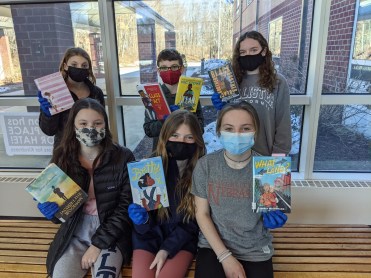
Karen Brenneke: The sixth-grade team teachers decided to build on the work of Wilton Reads [2021, which was centered around race, social justice and equity] and expand the vision of equity. So food insecurity was one of the topics. Diversity was another topic. Gender stereotyping was another, and issues of race was another choice. Our ELA [English Language Arts] curriculum emphasizes students’ voice and choice, so they could choose which topic through which they wanted to explore their ethical research.
Michael Gordon: [During the unit at Middlebrook], hearing students’ conversations was refreshing. Actually three instances, one with seventh grade and two with eighth grade, two different sets of students.
- A group of students came to band and they started talking about whatever texts they were reading, and it was dealing with issues of race. But it was refreshing for me to hear them being open about their questions. It wasn’t a sense of, ‘Well, why are we doing this?’ They were actually discussing among themselves: ‘What did you think about it? How did that reflect what you believe?’ Amongst seventh graders! I was like, wow! This is what we want. We want students to really dialogue and think on their own about what they’ve been taught and what they’ve learned, but also start to question and re-envision, and ask, ‘Well, why is that?’
- In the two eighth-grade classes, it was two different groups, two different times. One of the eighth-grade boys asked a question centered around what they were discussing — gender — in another class. And they said, ‘Why were women being treated unfairly?’ I asked what they were talking about, and they started to share with me what they were learning and how the discussion was going. As an educator, knowing that equity and diversity and inclusion are important, to hear them now discussing that on their own and trying to wrap their heads around, ‘Why wouldn’t [women] be treated fairly, why would they be excluded?’ I just found that refreshing.
Until this diversity, equity and inclusion work began, those conversations didn’t happen. I don’t ever recall having students outside of whatever classroom or whatever lesson, having [such] conversations. It was usually just in the classroom and once they were done, they were gone. So it’s really nice to hear that students now are feeling empowered to ask the questions and also feeling empowered to start to dive deeper and say, ‘Well, that’s not fair and let’s figure out why, and then make things happen to change it.’
GMW: On one hand, there’s been a shift within Wilton. There’s also a broader cultural shift, and we have very savvy kids in this town, in this part of the country, who get exposed to topics outside of school, independently. Michael, you also bring a really fascinating perspective having been involved with Wilton for many years before you were a teacher. [Editor’s Note: Michael Gordon’s family grew up in Bridgeport, and his brother attended Wilton High School as a participant in Project Concern; later as an adult, Gordon was the resident director for the ABC boys’ house.] Can you give some historical perspective about changes you’ve seen in Wilton that might reflect whether the community is ready for this conversation to happen productively in the schools and elsewhere outside?
Michael Gordon: Personally with my family, there were certain individuals in certain [Wilton] families who took up the mantle of, ‘Our community is not diverse and we’re missing out on other opportunities to engage in dialogue, to learn about other cultures, to have our children experience that.’ As families move to Wilton now, they are more diverse. Historically there has been a growing population, not just of people of color in Wilton to help that along, but also residents who are moving here saying, ‘We want more [diversity] because we know this benefits our children, to interact with different cultures and different ideas and different beliefs.” It’s been growing.
GMW: And for the administrators, how ready is this community for this conversation?
Chuck Smith: That’s a difficult question to answer because individuals are differently ready for this. What brought us to the point where this conversation is becoming a little bit more public, we’re not a bubble, right? There’s a large cultural effort to deal with these issues. And if you look at that letter from the [alumni] who had been through this [district] since 1987, saying to us that they didn’t feel we had done completely right by them on this topic. That prompted a lot of us to do some pretty hard reflection.
But we are trying to approach this in a way that takes into account the various readiness levels of members of the community. And to do this in a thoughtful, careful way that I hope will bring more people along in their readiness.
Kevin Smith: That input we got from those kids [in the alumni letter] was invaluable. What we’re doing is helping, alongside our parents, to educate and prepare our kids for a rapidly changing world. It’s a big world outside of Wilton and our kids need to be prepared with experiences here so they can be comfortable as they move beyond our borders.
Chuck Smith: I would also add, we want to make sure that our kids are prepared to make the world a better place. Our kids want to do that, and we need to be able to support them in doing that the right way. We’re trying to put into place a curriculum and an instructional framework that will do that in a way that hopefully doesn’t make certain members of our community feel uncomfortable.
Karen Brenneke: These aren’t radical changes. The alumni said in their letter that they weren’t asking for radical changes. We’re simply being more inclusive of diverse perspectives.
GMW: There are some qualitative words being used: “making the world a better place,” and “do good in the world.” And at the BOE workshop on diversity, equity and inclusion, one of the board members asked how you make sure that kids don’t walk away feeling that they’re “wrong” or uncomfortable on both sides. What happens when you hear from people that feel Wilton doesn’t need this? Who decides what’s “better”? Some people may believe Wilton doesn’t need this in the curriculum and this isn’t a conversation that should happen in school — that parents should talk with their own kids about how they believe or feel or approach things, not teachers. What’s your answer to that?
Chuck Smith: We’re trying to grow kids, right? Nothing we’re talking about is the sole responsibility, right? Everybody has input into the growth of the child and helping them to develop a good identity and to become a good citizen — home, school, church (if appropriate), community organizations — we all have a part in it. So I don’t view any of these topics as being the sole responsibility of any one entity. We have to work in partnership to do.
‘Why do we need to do this? And this issue of ‘a better world’? I give [BOE Chair] Debbie Low credit for this: Our society has aspirations, and it’s really important that kids understand this is an aspiration and we’re working towards it and it’s never work that will be done. We’ll never be perfect, but our role as citizens is to understand what we want our world to be, where we are, and how we function as agents to close that gap.
GMW: Is that monolithic? Saying, ‘This is the way we as a district believe.’? Some people may feel you’re ‘indoctrinating’ kids.
Chuck Smith: An important thing to understand, and I hope we’re being clear about it: Our role is not to teach kids what to believe. Our role is to give them the tools for figuring that out. We’re trying to teach kids how to inquire, to look at essential questions, to look at the evidence, and come up with their own beliefs.
Karen Brenneke: And to question the author, to seek other sources, to figure out what they believe. It’s not just what I [as a teacher] believe. It’s understanding other perspectives on the same topic and coming to [their own] conclusion.
Michael Gordon: As we increase our understanding of whatever [subject] it is, whether it’s math or culture or music, as we understand better, we can improve our own relationship with whatever that is. We can improve when it comes to equity, diversity and inclusion, how we treat each other, how we see each other. And that comes by understanding. I think that’s the goal here. We want to equip our students and by virtue of parents as well, to understand each other better. Because only then, that’s where the better world would come out. It’s not an ideal place. It’s that journey of constantly improving how we approach things, because we are constantly improving how we understand each other.
GMW: Sometimes parents will say, anecdotally, “There was a teacher in the classroom, the conversation about ‘X’ happened and I don’t think a teacher should be talking politics or their political beliefs or their religious beliefs …” Most likely, especially at Middlebrook or WHS, but even at the other schools, the conversations could turn personal and societal. What happens if that situation does happen — on a practical level for teachers, and then also on a policy level for the district?
Karen Brenneke: Talking about politics is not the same thing as sharing your personal political beliefs. And we do teach politics and civics from an apolitical stance. I don’t think that those are the same thing.
Michael Gordon: Trust, between teacher and student and parents as well, when the students share what’s happening, there’s a level of gauging the room with the teacher and the student and how the conversation comes up. If it’s related to something happening as part of the curriculum, or if it’s just something that kids are discussing that a teacher might want to step in and clarify, to make sure the children aren’t putting out misinformation or repeating something just offhand.
It’s not an easy thing to do. We all know that, but going back to that level of trust and understanding of the professional in the room. Some teachers have said, ‘I don’t do it because I don’t feel comfortable.’ And others have said, ‘I approach it delicately after listening. Inquiry: [asking the students,] ‘Why do you think that?’ ‘That’s interesting, where did you hear that from?’ ‘Has anyone else heard that?’ And they use that inquiry to bring other people into the conversation. That way it doesn’t get blown out of proportion or becomes something unintended.
GMW: How will you engage parents in this conversation?
Kevin Smith: Particularly around curriculum revisions, Karen will be publishing more information, plans are underway for a parent evening, so questions can be answered, and conversations can be had. But most importantly, and this is a truism, when parents have a question about anything, reach out first to the teacher and begin there. It’s our expectation that the teachers will respond. Then, if the conversation needs to expand from there…
GMW: What happens in individual cases where parents say, “This is not a text I want my child to read.”
Kevin Smith: I can’t think of an example when that’s happened. But like in some of our health classes, there are opt-out provisions. Subjects that people deem sensitive need to be handled sensitively and to Michael’s point about professional judgment and discretion, we rely heavily on teacher perspective there, and they certainly have an obligation to present information objectively and sensitively. But when a parent has a strenuous objection, he or she just needs to make that call [to the teacher]. And then we work with it at that teacher level or at the administrator level.
Karen Brenneke: I’m going to be sending letters out to families of our incoming sixth, seventh and eighth graders to address just that: how do we manage the ‘voice’ and ‘choice’? And if you have boundaries around what you want your child to read or not be exposed to, please have that conversation with your child’s teacher so that they can help guide your child to help make more sensible choices. Same for topics for research and for writing.
Those are important conversations. Those letters I view as an invitation to the conversation and a reminder to contact the classroom teacher. And we’ll be following up when there are some more sensitive choices on a choice-board for topics, making sure that families are aware of what those choices are, so they can have conversations to help guide their child’s choice.
GMW: During the BOE workshop, one BOE member asked whether the district was spending too much time on these topics and not enough on academic work.
Chuck Smith: That’s a false dichotomy.
Kevin Smith: It is academic.
GMW: So it’s not like you’re saying, ‘Today we’re going to teach diversity and tomorrow we’re going to teach math.’
Kevin Smith: You don’t teach diversity. You teach perspective-taking, which is a critical thinking skill, and critical thinking is really what we’re all about.
Michael Gordon: I’d just like to add, [being] responsive to the students’ voices who did speak about their experiences, both the alumni and some current students, just being responsive to what they’ve shared with us in their perspective, too, to just say, ‘We hear you, and we’re doing our best to try to make change happen so that you can see yourself throughout your day.’
Just as [Dr. Smith] said, we’re not ‘doing diversity.’ This is something we’re trying to get better at — understanding each other, seeing each other. It’s also for our students who spoke up and I want to recognize that and let them know that we’re responsive to that.
GMW: Outside of curriculum changes, are there also extracurricular efforts being made? How are students engaged outside the classroom?
Michael Gordon: At the high school, there’s the Racial Equity and Inclusion Club. There’s also a newly-formed BISOC — Black and Indiginous Students of Color — Advisory Board. Both of those are really run by the students to, again, amplify voices and bring their perspective to the table with, with both Dr. Smiths, Ms. Brenneke and I.
Again, we want to be responsive and students need to know that they also have a seat at the table, because that was one of the complaints in the [alumni] letter, [that they’re] not heard. Now we’re making efforts and students are stepping into those roles. Not that they weren’t before. It’s just, now that opportunity is here.
[embeddoc url=”https://goodmorningwilton.com/wp-content/uploads/2021/08/Copy-of-5.13.2021-BoE-Diversity-Equity-and-Inclusion-in-WPS.pdf” width=”80%” download=”all” viewer=”google”]


I want to thank GMW for all the details. Unfortunately, there seems to be a lot of disingenuity. Chuck Smith says “we don’t teach CRT here in Wilton,” yet one of the most widely recognized CRT texts, Lies My Teacher Told Me by Lames Loewen is absolutely being used for AP US History, despite being curiously omitted from the curriculum overview. Similarly, one of the highlighted professional learning activities was White Fragility, another CRT text …
Chuck Smith responds: “I think it’s important to distinguish between CRT texts and other literature that deals with issues of racism and history. Lies My Teacher Told Me and White Fragility are not CRT texts. They are books that address racial and/or historical issues, but are not texts about CRT. Also, specific texts are not typically listed in the course descriptions, but rather in the course outlines distributed by the teacher.”
Editor’s note: Lisa Pojano is a Republican candidate running in the Constable race for Election 2021. (Election 2021 Policies)
CRT under another name. More obfuscation by the Smith brothers.
Are parents in Wilton that obtuse to willingly subject their children to this nonsense?
For clarity, I referred to ‘widely recognized CRT texts,’ or ‘CRT genre’ of book. Unfortunately, two of the links I supplied in the original text were combined into one. Here they are again for reference: GoodReads Genres: Race-CRT-Politics and LitCharts
The book referred to also appears on several other GoodReads genre lists in addition to Race-CRT-Politics, including History, Nonfiction, Education, historical, teaching, politics, social movements, social justice, sociology, race, and many, many more.